

Building a Balanced Life: Honoring Creativity and Curiosity through Intellectual Wellness
When we think about wellness, we often focus on emotional, physical, or social health. Yet intellectual wellness (one of SAMHSA’s 8 dimensions of wellness) plays a vital and often overlooked role in healing, especially for individuals with trauma histories. Intellectual wellness is not about academic achievement or productivity. Rather, it is about nurturing curiosity, recognizing creative abilities, and expanding knowledge in ways that feel safe, meaningful, and empowering.

Building a Balanced Life: The Interconnected Nature of Physical Wellness
Holistic wellness. It isn’t just a buzzword in our society that you may have heard. Understanding and attending to your whole person - body, mind, and spirit - is vital to your overall wellbeing. Your body, mind, and spirit operate through an interconnectedness that we often do not consider when we go through the motions of daily life. Physical activity, nutrition, and sleep are all impactful on mental and emotional health. You are not isolated parts; you are one, whole, and beautiful system.

Building a Balanced Life: Occupational Wellness in an Imperfect System
Within SAMHSA’s 8 Dimensions of Wellness, occupational wellness is defined as personal enrichment and satisfaction derived from work. Importantly, this dimension does not exist in isolation. Our experience of work is deeply intertwined with other dimensions such as emotional, financial, social, and physical wellness. Occupational wellness is not about romanticizing labor. It is about understanding how work supports or strains our overall well-being.

Building a Balanced Life: Expanding Purpose & Meaning through Spiritual Wellness
Spiritual wellness is one of SAMSHA’s 8 dimensions of wellness. This realm of wellness emphasizes expanding one’s sense of purpose and meaning through spiritual engagement. As we speak about this realm of wellness, it is vital to emphasize that “spirituality” does not have to mean religion; instead, it can be anything that helps someone feel grounded, connected or purposeful.

Building a Balanced Life: Nourishing Yourself through Social Connection
Social wellness refers to our ability to build, maintain, and engage in healthy relationships with family, friends, and our broader community. It also reflects our capacity for empathy, connection, and care for others. When we intentionally invest in our social wellness, we cultivate a sense of belonging, support our emotional well-being, and strengthen meaningful connections. Research shows that strong social ties can lower cortisol levels, enhance self-esteem, and help us feel more resilient when navigating life’s challenges.

Building a Balanced Life: Trauma-Informed Financial Wellness
When people think about mental health, they often imagine emotions, relationships, and stress—not budgets, bills, or bank accounts. But financial wellness is one of the SAMHSA 8 Dimensions of Wellness for a reason. Our relationship with money deeply shapes our stress levels, sense of stability, and long-term wellbeing.
This is why Financial Wellness is included in the SAMHSA 8 Dimensions of Wellness. It’s not simply a practical category; it’s an emotional and relational one.

Building a Balanced Life: Establishing Emotional Wellness
In this dimension of wellness we focus on building a healthy connection to our emotions and being able to gather the information they provide us. Seeking emotional wellness may also include building healthy and effective coping strategies and establishing the necessary skills to have healthy, supportive relationships.
The Substance Abuse and Mental Health Services Administration (SAMSHA) states, “the emotional wellness dimension involves the ability to express feeling, adjust to emotional challenges, cope with life’s stressors and enjoy life.”
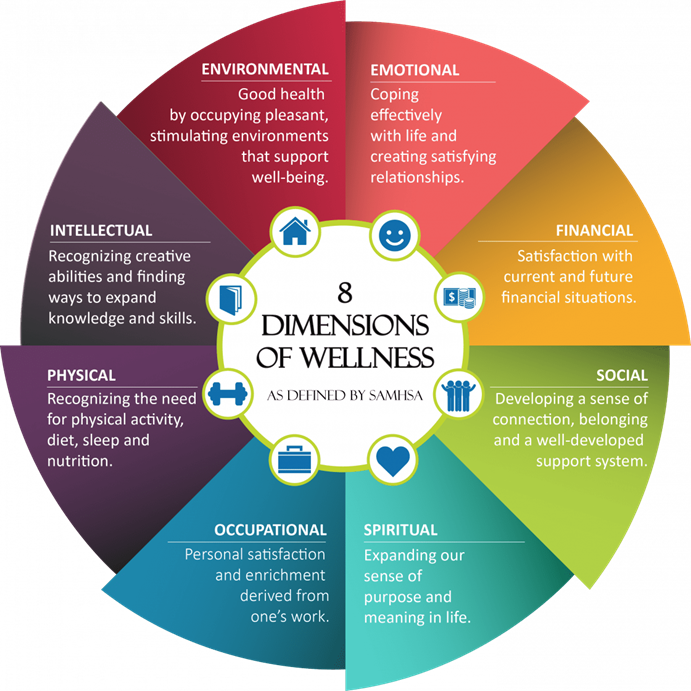
Building a Balanced Life: Insights from the 8 Dimensions of Wellness
Over the next 8 weeks, we will be looking at each of the 8 Dimensions of Wellness. The 8 Dimensions of Wellness are distinct areas that, when viewed together, form a holistic framework for health and well-being. Having a holistic view of wellness enables us to address the multiple aspects of our lives that are essential to our health. This model also shows that we cannot simply prioritize one realm of our well-being. Wellness is most attainable when the many different aspects of our lives work together to help us focus on living life fully.

The Empty Chair at the Table: Making Room for Grief and Love During the Holidays
As we grow up, we are taught that the holidays are a time of joy—meaningful gatherings spent with people we love, celebrating milestones, traditions, and togetherness. Yet, when you’ve lost someone dear to you, these same celebrations can feel hollow, painful, or isolating. The season’s reminders of love and connection can amplify absence and grief in ways that are both tender and heavy.
This pain can feel unbearable at times, and it’s normal to want to push it away or ignore it. But grief doesn’t disappear when avoided—it waits for acknowledgment. Getting to know your grief and understanding how it shows up in your life can help you move through it with more compassion and care.

Holding Space for Hope: Supporting a Loved One Struggling with Suicidal Thoughts
Hearing that a loved one is having thoughts of suicide can be frightening and overwhelming. You don’t want them to suffer, and you may not know what to say or do. But if your loved one has reached out to you, take heart—this is an important sign that they trust you and are open to help.
There are other signs that someone may be thinking about suicide, including but not limited to:
Talking about wanting to die or expressing hopelessness
Giving away belongings or getting affairs in order
Noticeable changes in mood, routine, energy, or personality
Engaging in risky or self-destructive behavior
Trying to obtain access to weapons or large amounts of medication
If you notice any of these warning signs, reach out and talk with your loved one. Asking directly about suicide will not “give them the idea.” In fact, it can open a life-saving conversation. Try to stay calm, compassionate, and present—your steady support can make a world of difference.

The Healing Power of Purpose: How Meaningful Action Supports Mental Health
The age-old question many people face is: What is their purpose? What pushes them to be better and gives them goals that they can aim for? Before you can ask yourself these questions, you must first define what purpose is. Everyone has their own purposes that affect their day-to-day life. It can be hard to know where to start figuring out your purpose.
If you feel you have not yet found your purpose, reflecting on your values and how you define success and meaning can be a helpful first step. If you are struggling to identify your purpose or values, this could be a very beneficial conversation to explore in therapy.

Setting Goals and Defining Progress in Therapy
When you first start therapy, it can be helpful to set some goals you want to accomplish during your time with your therapist. Some examples of relevant goals to discuss with your therapist could include:
Learning better methods for dealing with anxiety
Having a space to process something happening in your life
Developing healthy communication skills to improve personal relationships
Discovering your identity and values to guide you through a season of change or transition

Separating Facts from Fear: Recognizing Real vs Imagined Threats
CBT interventions for Anxiety have been proven time and time again to be extremely helpful. CBT helps shift anxious thoughts to access the underlying helpful information your emotions are trying to communicate. Rather than focusing on your anxiety about an activity, CBT enables you to shift your mindset to planning tasks that prepare you for it. CBT can also help challenge “black-and-white” thinking, where we label things as either bad or good. It can help you acknowledge that an event can be a mix of both, where it wasn’t only bad but it wasn’t only good.

Managing ADHD Symptoms
October serves as ADHD awareness month, which helps to remind us to move from stigma toward understanding.
The purpose of learning to manage your ADHD symptoms is not to “fix” yourself, but rather a way to support yourself toward success by leaning on your strengths and systems that work for you. It is possible for you to thrive with ADHD.

Emotional Labor and the Myth of Holding it All Together
What Is Emotional Labor—and How Does It Lead to Overwhelm in Our Lives?
Think of emotional labor as your home’s thermostat. While it quietly keeps things running smoothly, its importance often goes unnoticed. Yet, it plays a vital role in maintaining balance and comfort for everyone inside.

Why Mental Health Care Is Just Health Care - Period.
Societally there is still a difference in perception when it comes to seeking health care for a physical ailment as opposed to seeking professional help for mental health care.
Seeing a doctor for a broken bone is common sense, while many people struggling with common mental health conditions - depression, anxiety, or relational distress - do not feel as confident about seeking support from a therapist.

The Gentle Power of Starting: Beginning Your Therapy Journey
Starting therapy is a courageous choice. The good news is that you don’t have to have it all figured out in order to take the first step. Give yourself permission to take the first step - whatever that means for you.

Introducing Anna Grace!
Anna Grace is a Master’s level clinical intern, studying to be a Licensed Professional Counselor in Colorado. She loves to work with teens and young adults navigating life’s challenges and transitions.
Her approach is holistic and integrative, acknowledging the complexity of human existence.

Coping With Anxiety: Ways You Can Help Reduce Your Anxiety
Life can often feel overwhelming, and anxiety can build up. Anxiety is something that affects many people and is known to manifest differently in everyone. Having coping methods to help reduce anxiety is extremely important and can help you live a more well-rounded life. Socializing, spending time outdoors, and maintaining a healthy diet are all fantastic ways to help decrease anxiety. However, it is important to note that you do not have to complete every single one of these suggested activities, as one method may work well for you while the others may not. How you help alleviate your anxiety is up to you.

National Suicide Prevention Month: How to Support a Loved One Struggling with Suicidal Ideation
“When someone you care about is navigating suicidal thoughts, it can feel like standing in a storm with no guidance or direction. You want to help - but it feels like you may say the wrong thing, not do enough or that you may make it feel worse. The truth is, your presence, your willingness to support them and you being a listening ear can be life-changing.””